Today it was all about Italian food. Our recipes for today: focaccia bread, stuffed meat balls, fresh pasta, tomato sauce, and a lemon dill cream sauce.
We started out by measuring out the ingredients for a focaccia bread. Today's focaccia bread is served with our pasta. It's a simple focaccia bread with an oil and coarse salt topping.
Working in a kitchen making different dishes is all about time management. Because bread needs yeast ~ we need to wait for the yeast to bloom. While that is happening, we can work on our mise en place for the pasta dishes that we will be preparing today ~ spaghetti and meatballs and lemon dill pasta. Our mise en place for the first dish was onions, red pepper, green pepper and garlic. For our second dish it was garlic, lemon zest, and garlic.
After the yeast bloomed we make our dough for the focaccia bread and let it rise to double it's size. While we waited for the dough to rise, we started making our first sauce ~ tomato sauce. We saute our onions in oil and seasoned with salt and pepper, add the peppers (red and green) and herbs such as thyme and basil to build the flavours for the sauce. We also added other optional enhancers such as Worcestershire and balmai (sarachia). Next we add some canned tomatoes and their juice and continued to season adding sugar, salt and pepper. The sugar helps to cut the acid taste that you get from the tomatoes. When all ingredients have been incorporated, the sauce is left to simmer on the stove.
We are back to the focaccia dough that has now rise and spread it out on a small baking sheet. We do not want this focaccia dough to rise in the baking, so we punch it down with our finger tips. After we have done this we brush oil over the top and sprinkle sea salt all over and put it in the oven to bake at 375 F.
In a hot sauce pan with oil we saute onions and season with fresh thyme, salt and pepper. When the onions become soft we hit the pan with some white wine to deglaze (which removes the brown bits from the pan) and let it cool to be used later for making the meatballs.
We're ready to make the pasta and measure out some flour, salt and oil. To the flour and salt we mix in oil and two eggs ~ mix and knead the dough until we get the right texture for pasta. Once the dough is ready we wrap it in saran wrap and let it sit for a bit before we roll it out in a pasta machine.
It's time to make the stuffed meatballs. We are using a mixture of pork and beef to make our meatballs. The stuffing is cream cheese and shredded mozzarella and cheddar cheese. The meatballs are a fair size ~ smaller than a tennis ball and bigger than a golf ball. For a regular serving, we would plate about three meatballs. Mine are kind of large and I'll likely plate one for Chef to taste and critique. The meatballs are put in the oven to cook at 350 F turning halfway through cooking.
The tomato sauce should be just about ready now and we get the immersion blender and give it a good buzz to break down all the ingredients in to a smooth sauce. It takes a few minutes to do this and the pot of tomato sauce is back at the stove to use later.
Getting back to the pasta dough, we set up the pasta roller and roll the pasta starting with the largest thickness (number one). With each pass through the rollers, we decrease the thickness by one for five passes in total. After the fifth pass we are ready to cut the pasta. With the first serving (half the pasta dough made) we put the dough through the linguine rollers and hang the pasta to dry on a pasta dryer. Next we run the second serving of dough through the angle hair rollers and put the pasta to dry until we are ready to use for our dishes.
Everything is just about ready and Chef wants us to plate the lemon dill pastas and then the paghetti and meatballs. To a pot of boiling water seasoned with salt we add our angle hair pasta. For the lemon dill pasta, in a large sauce we add butter and saute the garlic and lemon zest, deglaze with white wine and add cream. We leave the sauce to reduce by about half. When the sauce has reduced and the pasta is al dente, the pasta is tossed in to be mixed with the sauce. The pasta is plated on a warm plate with a few slices of focaccia.
Up next is spaghetti and meatballs. First we add our linguine pasta to a pot of hot boiling water seasoned with salt. To a sauce pan we add our meatballs (enough for one serving) and tomato sauce and heat through. When the pasta is ready we plate the pasta (on a warm plate), top with meatballs (in my case one meatball) and tomato sauce with a few slices of focaccia bread for Chef to taste and critique.
One thing that Chef likes us to keep in mind is that when serving hot food, that it should be served on a warm plate. The warm plate helps in keep the food being served hot. A cold plate will cool down hot food too quickly... and cold food does not taste very good at all! Unless it's pizza the next morning ;-)
It was a busy day in the kitchen and there were lots of dishes, pots and pans to clean up. We were kept busy from beginning to end. No time for eating any of our dishes at school today. Still not getting use to eating dinner meals at breakfast time anyway ~ and I'm good to wait until I get home.
Thinking about homework tonight and testing out how to cost out my recipes. Need to put some work in to the project as the weeks are beginning to rush by quickly.
Monday, May 2, 2011
Sunday, May 1, 2011
Day 32: Breakfast of Champions
It was a quick day in the kitchen today learning how to make the perfect stir fry served with rice. For the stir fry we jullienned vegetables that were left over from this week ~ an assortment of red and green peppers, mushrooms, onions, asparagus, cauliflower, broccoli, carrots, and green beans.
For today's dish ~ a breakfast of champions ~ I made half a cup of uncooked par boiled rice. The ratio for cooking this rice is two parts water to one part rice. Rice doubles in size and for half a cup of uncooked rice we get one cup of cooked rice. To give the rice a bit of flavouring, we added ginger and a pinch of saffron to the rice.
For the sauce I minced some ginger and garlic and sauteed it in butter. I began building the flavours of the sauce by adding salt and pepper, and a pinch of allspice. Next I added coconut milk and a whole Thai chili pepper sliced, followed by about half a litre of chicken stock and let it simmer to reduce the sauce by about half.
I started the stir fry with sauteing onions first, then adding an assortment of julienned (thin sliced strips) vegetables. The stir fry was seasoned with salt, pepper, allspice, worcestershire sauce, fish sauce, and soy sauce.
When the rice was done and the stir fry cooked to al dente, I cooked a few shrimp (peeled with tails left on and seasoned with salt) in the coconut sauce. The stir fry was placed over the rice with the shrimp and coconut sauce on top.
This dish was so delishous! The shrimp was cooked perfectly. Shrimp when cooked properly should look like an open "C". Overcooked shrimp will look liken an "O". I loved the flavour of the coconut milk and the heat from the Thai red pepper. I was pretty happy about this dish ~ Chef commented that I had cooked the rice and shrimp perfectly.
It was a short day in the kitchen as we moved to the classroom to discuss our food business plan project. Chef helped us with the requirements of the project and surveyed the class to find out what our projects were going to be about. There is lots to do for this project ~ we are required to cost out each of our dishes/recipes as well as complete a two day preparation plan.
Homework this weekend will be to work on my project and make rye bread. I purchased some flax seeds and sunflower seeds to add to the rye bread.
For today's dish ~ a breakfast of champions ~ I made half a cup of uncooked par boiled rice. The ratio for cooking this rice is two parts water to one part rice. Rice doubles in size and for half a cup of uncooked rice we get one cup of cooked rice. To give the rice a bit of flavouring, we added ginger and a pinch of saffron to the rice.
For the sauce I minced some ginger and garlic and sauteed it in butter. I began building the flavours of the sauce by adding salt and pepper, and a pinch of allspice. Next I added coconut milk and a whole Thai chili pepper sliced, followed by about half a litre of chicken stock and let it simmer to reduce the sauce by about half.
![]() |
| I forgot to take a photo of my plating before Chef tasted the components of my dish. |
When the rice was done and the stir fry cooked to al dente, I cooked a few shrimp (peeled with tails left on and seasoned with salt) in the coconut sauce. The stir fry was placed over the rice with the shrimp and coconut sauce on top.
This dish was so delishous! The shrimp was cooked perfectly. Shrimp when cooked properly should look like an open "C". Overcooked shrimp will look liken an "O". I loved the flavour of the coconut milk and the heat from the Thai red pepper. I was pretty happy about this dish ~ Chef commented that I had cooked the rice and shrimp perfectly.
It was a short day in the kitchen as we moved to the classroom to discuss our food business plan project. Chef helped us with the requirements of the project and surveyed the class to find out what our projects were going to be about. There is lots to do for this project ~ we are required to cost out each of our dishes/recipes as well as complete a two day preparation plan.
Homework this weekend will be to work on my project and make rye bread. I purchased some flax seeds and sunflower seeds to add to the rye bread.
Day 31: French Onion Soup au Gratin!
We are making french onion au gratin soup today. The veal stock that we began making on Monday is to be used for the soup. Veal stock is the best for a french onion soup. Our mise en place for the french onion soup is two onions, thinly sliced. We caramelize the onions in butter and oil (oil helps with the smoke point) and season with season with salt and pepper. When the onions are just about done we hit the sauce pan with a splash of sherry creating a burst of flames. When the alcohol has evaporated, I add three or four ladles of veal stock. I simmer the soup of onions until it reduces by half. I fill the soup bowl with onion soup, french bread, shredded mozzarella, and cover it with a slice of Swiss cheese and top with grated Parmesan cheese. The soup is put under the broiler for the cheese to bubble and then brown. As usual we get to eat what we make ~ french onion soup au gratin at 9:30 a.m. in the morning!
Ratatouille is a quick recipe that can be eaten as a side, a starter or part of a dish such as pasta. The mise en place for this dish was equal size cuts of eggplant, onion, zucchini and tomato.
We had a few eggplants left and chef had us making breaded eggplant. We had a breading station that consisted of flour, egg, and panko crumbs (white bread crumbs). The eggplant was sliced rounds of half an inch thickness and sprinkled with salt then put through the breading station. Oil was heated for the eggplant to be deep fried. When the eggplant was taken out of the oil, it was hit with a light sprinkle of salt. These breaded slices of eggplant were so good and so much better than using bread crumbs (typical bread crumbs include the crust). We all worked together in making this dish with everyone either working on preparing, cooking, or eating.
Another vegetable side we made and our last dish of the day was sauteed mushrooms. Very easy to make and build the flavours. We first cut the mushrooms in quarters and then sauteed them in butter and oil, with salt and pepper cooking them to a nice colour of brown. When we reached the desired colour of brown for the mushrooms, we give them a splash of sherry and continued to cook them until the liquid has evaporated. This is a great side for a steak and very inexpensive to make.
Homework tonight is to print off what I have completed on my business plan project.
Ratatouille is a quick recipe that can be eaten as a side, a starter or part of a dish such as pasta. The mise en place for this dish was equal size cuts of eggplant, onion, zucchini and tomato.
We had a few eggplants left and chef had us making breaded eggplant. We had a breading station that consisted of flour, egg, and panko crumbs (white bread crumbs). The eggplant was sliced rounds of half an inch thickness and sprinkled with salt then put through the breading station. Oil was heated for the eggplant to be deep fried. When the eggplant was taken out of the oil, it was hit with a light sprinkle of salt. These breaded slices of eggplant were so good and so much better than using bread crumbs (typical bread crumbs include the crust). We all worked together in making this dish with everyone either working on preparing, cooking, or eating.
Another vegetable side we made and our last dish of the day was sauteed mushrooms. Very easy to make and build the flavours. We first cut the mushrooms in quarters and then sauteed them in butter and oil, with salt and pepper cooking them to a nice colour of brown. When we reached the desired colour of brown for the mushrooms, we give them a splash of sherry and continued to cook them until the liquid has evaporated. This is a great side for a steak and very inexpensive to make.
Homework tonight is to print off what I have completed on my business plan project.
Day 30: Four in One
Today we worked on four recipes in one day. We arrive in our class to the aroma of the veal stock that had been simmer all night. The stock is ready to use and we drain off a huge amount to be vented (cooled down using bottled of frozen water immersed in the veal stock) and then stored in our refrigerator for use later.
Chef begins our day with gathering the ingredients for a french bread. After we have kneaded the dough for the french bread we leave it in the oven to proof so that we can start on the next recipe ~ Pho Bo. During our first week in the kitchen we made a french bread that was stuffed with prosciutto, basil, sun dried tomatoes and feta cheese.
Pho is an easy soup to make. We use rice noodles which need to be soaked in hot water to rehydrate. The base of the soup is the veal stock that we had simmering overnight. To make our soup we add to one litre of stock minced lemon grass, minced garlic, minced ginger, tofu, (two) whole Thai peppers, Thai basil and thinly sliced onions. We season the soup with salt and pepper to taste also adding soy sauce, oyster sauce, honey, five spice to bring the flavour of a pho bo soup. When all ingredients are simmered and flavoured properly to match what Chef has made, we begin plating our soup. For starters I have warmed a bowl ~ to the bowl I add rice noodles, and four thinly sliced pieces of beef flank steak. The hot soup is poured over the beef and rice noodles. The heat from the soup cooks the beef and I decorate with a few sprigs of Thai basil and the chili peppers ready for Chef to sample and provide a critique.
Our french bread has proofed and we are ready to roll it out to the shape of a baguette and leave it to rise before putting it in to a 375 F oven to bake. We will be using a few slices from the baguette our french onion soup tomorrow.
After we have had our soup, we start on the next soup ~ a mint green pea soup. We are using a chicken stock for this soup as the base. In a pot with butter we add the small diced onions and start building the flavours with pepper and salt to taste. Next we add sliced leeks, sliced garlic and sliced ginger sweating these with the onions and then add a small bunch of mint leaves and frozen green peas. Chicken stock is added to the pot to just cover the green peas and is simmered for about five minutes to develop the flavours of the soup. The peas should not be over cooked because you want a bright green colour for the soup. After approximately five minutes, the soup will need to be buzzed (broken down) with an immersion blender and strained. If the soup is too thin ~ cooked over the stove to reduce and thicken. During this process, tasting and seasoning is required to acquire the right taste and texture as demonstrated by Chef.
With two soups and a bread completed we finish off with glazed root vegetables. We use carrots and parsnips for this side dish. The vegetables are cut coarsely and then par boiled in salted water. When they are tender, but a little al dente, they are ready to be put in to a sauce pan with clarified butter. Clarified butter is used because it has a higher smoking point. To the root vegetables, we add a pinch or two of cumin, salt and pepper to taste and some honey to create the glaze on the vegetables. The vegetables are sauteed. When finished they will have nice colour and a caramelized glaze which comes from the honey and butter as well as the sugar that is released from the vegetables.
No homework for me tonight. I will put more work in to my business plan project later this week.
Chef begins our day with gathering the ingredients for a french bread. After we have kneaded the dough for the french bread we leave it in the oven to proof so that we can start on the next recipe ~ Pho Bo. During our first week in the kitchen we made a french bread that was stuffed with prosciutto, basil, sun dried tomatoes and feta cheese.
Pho is an easy soup to make. We use rice noodles which need to be soaked in hot water to rehydrate. The base of the soup is the veal stock that we had simmering overnight. To make our soup we add to one litre of stock minced lemon grass, minced garlic, minced ginger, tofu, (two) whole Thai peppers, Thai basil and thinly sliced onions. We season the soup with salt and pepper to taste also adding soy sauce, oyster sauce, honey, five spice to bring the flavour of a pho bo soup. When all ingredients are simmered and flavoured properly to match what Chef has made, we begin plating our soup. For starters I have warmed a bowl ~ to the bowl I add rice noodles, and four thinly sliced pieces of beef flank steak. The hot soup is poured over the beef and rice noodles. The heat from the soup cooks the beef and I decorate with a few sprigs of Thai basil and the chili peppers ready for Chef to sample and provide a critique.
Our french bread has proofed and we are ready to roll it out to the shape of a baguette and leave it to rise before putting it in to a 375 F oven to bake. We will be using a few slices from the baguette our french onion soup tomorrow.
After we have had our soup, we start on the next soup ~ a mint green pea soup. We are using a chicken stock for this soup as the base. In a pot with butter we add the small diced onions and start building the flavours with pepper and salt to taste. Next we add sliced leeks, sliced garlic and sliced ginger sweating these with the onions and then add a small bunch of mint leaves and frozen green peas. Chicken stock is added to the pot to just cover the green peas and is simmered for about five minutes to develop the flavours of the soup. The peas should not be over cooked because you want a bright green colour for the soup. After approximately five minutes, the soup will need to be buzzed (broken down) with an immersion blender and strained. If the soup is too thin ~ cooked over the stove to reduce and thicken. During this process, tasting and seasoning is required to acquire the right taste and texture as demonstrated by Chef.
With two soups and a bread completed we finish off with glazed root vegetables. We use carrots and parsnips for this side dish. The vegetables are cut coarsely and then par boiled in salted water. When they are tender, but a little al dente, they are ready to be put in to a sauce pan with clarified butter. Clarified butter is used because it has a higher smoking point. To the root vegetables, we add a pinch or two of cumin, salt and pepper to taste and some honey to create the glaze on the vegetables. The vegetables are sauteed. When finished they will have nice colour and a caramelized glaze which comes from the honey and butter as well as the sugar that is released from the vegetables.
No homework for me tonight. I will put more work in to my business plan project later this week.
Day 29: Stocks and Soups
The week begins with a huge veal stock. Chef has us working on browning veal bones in the oven and cutting up the mire poix of onions, carrots, and celery and left over leeks from one of her night classes. After the veal bones were browned, they were put in the stock pot. The mire poix was sauteed in the pans over the stove and then also put in to the stock pot. A sachet was made of leeks and thyme then put in to the stock pot. We poured cold water in the stock pot about three to four inches below the top of the pot and put the heat on for it to cook for at least six to eight hours. We are going to simmer the stock over night which should give us a great tasting stock.
,
Our first soup was a minestrone. To prepare the ingredients for the soup, we practiced our dice cuts. We were asked to mince about a quarter of an onion, small dice red and green pepper, zucchini, carrots, and chiffonade some nappa cabbage, and par boil some pasta.
To begin making the soup, I started with defrosting a litre of chicken stock for the soup. To a saute pan, I started building the flavours for the soup first with adding some butter and then sauteing the onions and seasoning with salt and pepper. To this I added the green and red peppers next and then the carrots and zucchini, canned plum tomato, kidney beans and chickpeas. I added some seasoning of thyme and more salt and pepper as needed. For more flavour building, I added bahmi (a siracha sauce), Worcestershire, and honey and then added the chicken stock. With all the ingredients simmering together, I checked for balance of flavour and added salt, pepper, honey or more bahmi. I tasted Chefs' soup to compare with mine until I got my soup to the same flavour match. Just before plating my soup in a heated bowl, I added the nappa cabbage and presented it to Chef to taste. A cold soup does not taste the same as a hot soup. A cold soup (or cold food) will not provide the true taste of a dish. Heat brings out the flavour and the salt in foods. You should never season a cold plate that is mean to be served hot because you may over salt it. Chef said that it was a pretty good soup, but needed a little more salt.
After taking a break and having a bowl of our soup, we made spanakopita. Spanakopita is a phyllo pastry made with a savoury or sweet filling. We made a savoury spanakopita with an Indian influence. I made a vegetarian pastry by combining onions, carrots, green and red peppers, cauliflower, broccoli, chickpeas, curry powder, turmeric, honey, salt and pepper to taste. I found the phyllo dough hard to work with as it can break easily if handled too much. Each thin layer must be brushed with butter. The filling was wrapped in phyllo in the shape of a triangle then baked in the oven at 425 F.
I am no longer the sous chef and very happy that I have already done my week. At the end of clean up we were sent to the classroom to write out the recipe for the veal stock and the minestrone soup.
I am taking the day off from homework.
,
Our first soup was a minestrone. To prepare the ingredients for the soup, we practiced our dice cuts. We were asked to mince about a quarter of an onion, small dice red and green pepper, zucchini, carrots, and chiffonade some nappa cabbage, and par boil some pasta.
To begin making the soup, I started with defrosting a litre of chicken stock for the soup. To a saute pan, I started building the flavours for the soup first with adding some butter and then sauteing the onions and seasoning with salt and pepper. To this I added the green and red peppers next and then the carrots and zucchini, canned plum tomato, kidney beans and chickpeas. I added some seasoning of thyme and more salt and pepper as needed. For more flavour building, I added bahmi (a siracha sauce), Worcestershire, and honey and then added the chicken stock. With all the ingredients simmering together, I checked for balance of flavour and added salt, pepper, honey or more bahmi. I tasted Chefs' soup to compare with mine until I got my soup to the same flavour match. Just before plating my soup in a heated bowl, I added the nappa cabbage and presented it to Chef to taste. A cold soup does not taste the same as a hot soup. A cold soup (or cold food) will not provide the true taste of a dish. Heat brings out the flavour and the salt in foods. You should never season a cold plate that is mean to be served hot because you may over salt it. Chef said that it was a pretty good soup, but needed a little more salt.
After taking a break and having a bowl of our soup, we made spanakopita. Spanakopita is a phyllo pastry made with a savoury or sweet filling. We made a savoury spanakopita with an Indian influence. I made a vegetarian pastry by combining onions, carrots, green and red peppers, cauliflower, broccoli, chickpeas, curry powder, turmeric, honey, salt and pepper to taste. I found the phyllo dough hard to work with as it can break easily if handled too much. Each thin layer must be brushed with butter. The filling was wrapped in phyllo in the shape of a triangle then baked in the oven at 425 F.
I am no longer the sous chef and very happy that I have already done my week. At the end of clean up we were sent to the classroom to write out the recipe for the veal stock and the minestrone soup.
I am taking the day off from homework.
Day 28: Good Day Food Day
Fun day of plating today. We plated our chocolate mousse deserts made yesterday. To compliment the desert, Chef showed us how to work with the sugar to create designs for plating. Chef also showed us how to make caramel and tulle. All of these techniques were options to use in plating our deserts.
For my desert I used sugar work, blueberry coulis, strawberries, and mint leaves. I tend to work free hand when coming up with a design for my plate. Because we started with a sugar work demonstration I decided to start with this method first. I began by drizzling the sugar on to parchment paper making random patterns. I like to use freehand to see what I come up with and work from there. By stretching the sugar I made sugar strings that looked like floss. From this an idea came to me to make little berries with mint leaves on top. This idea came to me because there were no more raspberries left for me to use. I used my hands to shape the berries to their final shape.
What I didn't know at the beginning of the day was that we would be graded on our food technique and plating. The technique included taste and texture of the Genoise cake, chocolate mousse, and coulis. The plating was marked on composition of the pulled sugar designs, placement of chocolate mousse and accompaniments (i.e. coulis, fruit, pulled sugar). I felt that my plate was simple yet pleasing to the eye. In addition to being marked on our work, we were all invited to taste each other's chocolate mousse to get our palates use to different textures. A mousse is suppose to light and airy and melt in your mouth.
After we had eaten our deserts, we made another ~ crepes with flambe bananas.
Crepes are actually very easy to make but also very time consuming. A crepe is a thin version of a pancake. However, in making a crepe you do not add baking powder. I was having a bit of a problem making the crepes ~ swirling the crepe mixture on the pan evenly. Chef came over and gave me a few pointers on how I could do this easily. Chef told me to pour the mixture at the twelve o'clock and swirl it clockwise to cover the pan evenly and quickly. With a thin layer of batter, it cooks very fast, so you have to move quickly when spreading the mixture. Rolling the crepe came much easier. For the filling we made flambe bananas using butter, honey and some sherry. Sherry is what gave it the flambe (fire). Chef also wanted us to plate our desert using caramel that we had made. To make the caramel, we added cream to the leftover sugar that was used for the sugar work in our chocolate mousse plate.
It was a fun day today with plating and making these delicious deserts. I'm looking forward to more plating and cooking.
For my desert I used sugar work, blueberry coulis, strawberries, and mint leaves. I tend to work free hand when coming up with a design for my plate. Because we started with a sugar work demonstration I decided to start with this method first. I began by drizzling the sugar on to parchment paper making random patterns. I like to use freehand to see what I come up with and work from there. By stretching the sugar I made sugar strings that looked like floss. From this an idea came to me to make little berries with mint leaves on top. This idea came to me because there were no more raspberries left for me to use. I used my hands to shape the berries to their final shape.
What I didn't know at the beginning of the day was that we would be graded on our food technique and plating. The technique included taste and texture of the Genoise cake, chocolate mousse, and coulis. The plating was marked on composition of the pulled sugar designs, placement of chocolate mousse and accompaniments (i.e. coulis, fruit, pulled sugar). I felt that my plate was simple yet pleasing to the eye. In addition to being marked on our work, we were all invited to taste each other's chocolate mousse to get our palates use to different textures. A mousse is suppose to light and airy and melt in your mouth.
After we had eaten our deserts, we made another ~ crepes with flambe bananas.
Crepes are actually very easy to make but also very time consuming. A crepe is a thin version of a pancake. However, in making a crepe you do not add baking powder. I was having a bit of a problem making the crepes ~ swirling the crepe mixture on the pan evenly. Chef came over and gave me a few pointers on how I could do this easily. Chef told me to pour the mixture at the twelve o'clock and swirl it clockwise to cover the pan evenly and quickly. With a thin layer of batter, it cooks very fast, so you have to move quickly when spreading the mixture. Rolling the crepe came much easier. For the filling we made flambe bananas using butter, honey and some sherry. Sherry is what gave it the flambe (fire). Chef also wanted us to plate our desert using caramel that we had made. To make the caramel, we added cream to the leftover sugar that was used for the sugar work in our chocolate mousse plate.
It was a fun day today with plating and making these delicious deserts. I'm looking forward to more plating and cooking.
Day 27: Doing It Again ~ Chocolate Mousse Desert!
We are making the chocolate mousse desert in class today. We are practicing our techniques by making the Genoise cake (sponge cake) ~ which is used for the base of the desert. The chocolate mousse will be used to fill the desert. The blueberry coulis will be used in plating the desert. We will be marked on our deserts at some point in our ten weeks in the kitchen.
I made two preparations of the chocolate mousse desert ~ one with a small ring and the other with the larger ring. I took the larger one home to practice on my plating technique.
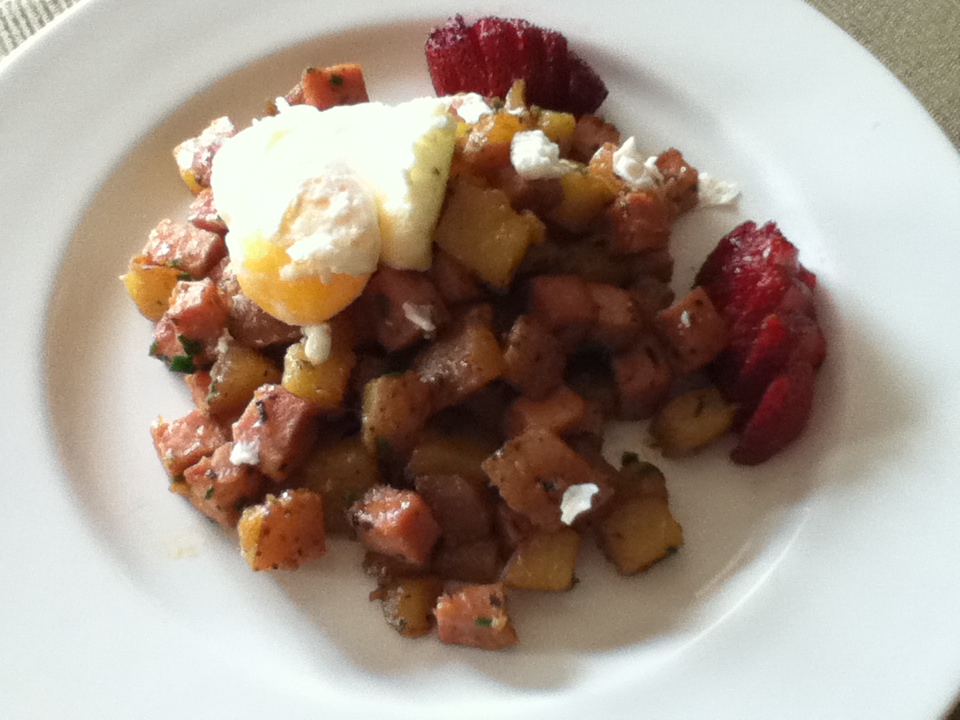
After we prepared our chocolate desert mousse for plating tomorrow Chef got us started on making a breakfast. We made a poached egg, sauteed spinach and potato ham and onion hash. The potato and ham were diced and the onion sliced. To the poaching water we added a spoon of vinegar. This helps in keeping the egg together. To finish off the dish, we sauteed spinach with garlic and butter. I plated the potato with spinach on top and on top of the spinach the soft poached egg.
I didn't get a chance to take a picture of the potato egg, spinach and poached egg I had made at school. I made it at home without the sauteed spinach. My plating didn't look as nice as what I did at school, but it still taste good.
I make a variation of the dish made at school. At home I diced potato and ham and fried them with onions. I put them in a casserole dish and added scrambled egg. I made a frittata with some of the same ingredients used at school. It was very yummy!I passed on homework tonight.
Subscribe to:
Posts (Atom)